



Lighting Designed to Move With the Wind Alfresco Bar Lighting at Atwell Arcade, Fremantle
The businesses of Atwell Arcade in Fremantle were building a timber bar in their shared courtyard. We designed and installed the lighting, taking the cue from old jetty lamps that move in the wind.

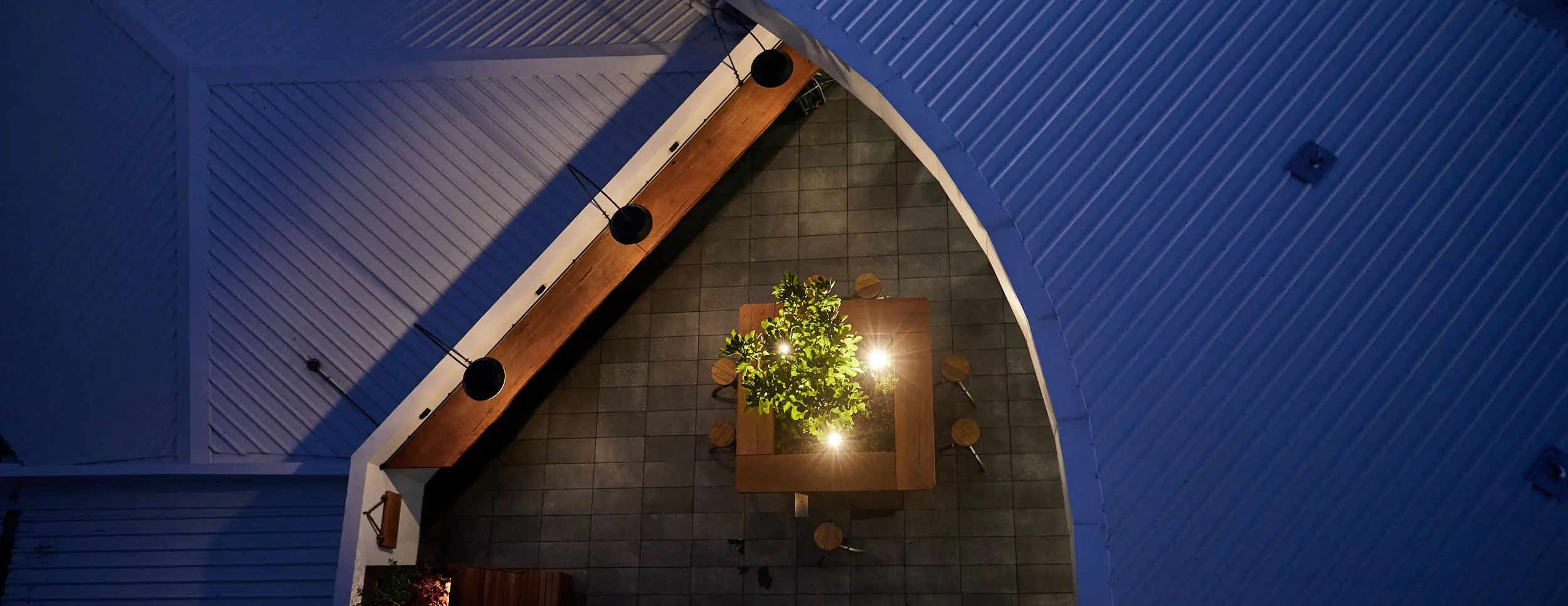
There is a courtyard in the middle of Atwell Arcade in Fremantle, tucked between the old arcade buildings and the newer block behind them. The businesses there were building it out as a shared alfresco area, a timber frame bar with a long counter, a communal table and seating, and a fig tree in the middle of it. They came to us to design and install the lighting.
That is a different job to wiring an outdoor area. Wiring it is a day’s work and a set of outlets. Designing it means deciding what the place is supposed to feel like after dark, and then working backwards to fittings, positions and light levels that produce that feeling. If you skip the first part you end up with a well-built installation that nobody wants to sit under.
What an outdoor bar actually needs from its lighting
An alfresco area has to do two contradictory things at once, and this is the whole design problem.
It has to be dark enough to feel like an evening. People go outside at night because it is not the inside of an office. Flat, even, bright light is correct for a workshop and completely wrong here. If you light a courtyard to the level you would light a car park, people sit in it once.
It also has to be light enough to use. Somebody has to be able to read a menu, find the step, pour a drink and see the person across the table. Too atmospheric and it stops being a usable space.
The way through is not a single light level. It is several small pools of warm light at low mounting heights, with dark in between them. Your eye reads that as an evening. A single bright source overhead reads as a room with the lights on.
The third constraint is that everything out there is outside. Fremantle is a port suburb, a few hundred metres from the water, and the salt in the air is unkind to anything with a poor finish or the wrong fixings. Fittings, outlets, glands and conduit all get chosen with that in mind, not just the light output.
The idea: old jetty lighting
Fremantle gives you the theme for free.
The reference we worked to was the lighting along an old timber jetty. Lamps on curved arms hanging out over the water, hung rather than fixed rigid, moving slightly in the breeze. A warm, low, slightly hazy light. Not much of it, and all of it close down over the deck.
That is the feeling we set out to reproduce over a timber bar in a Fremantle courtyard, and once you have committed to a reference like that, most of the individual decisions make themselves.
What we installed
Gooseneck pendants on curved arms
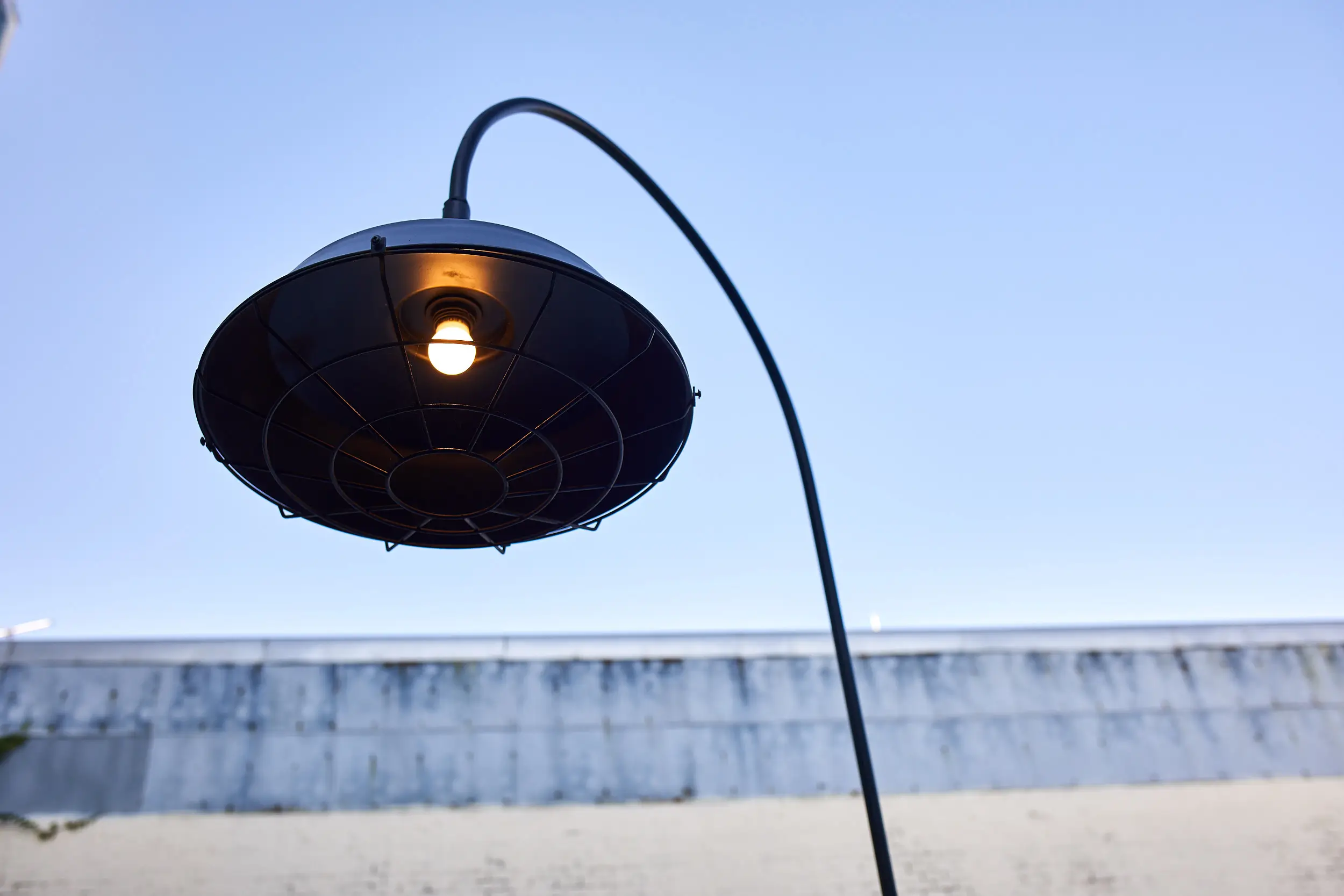
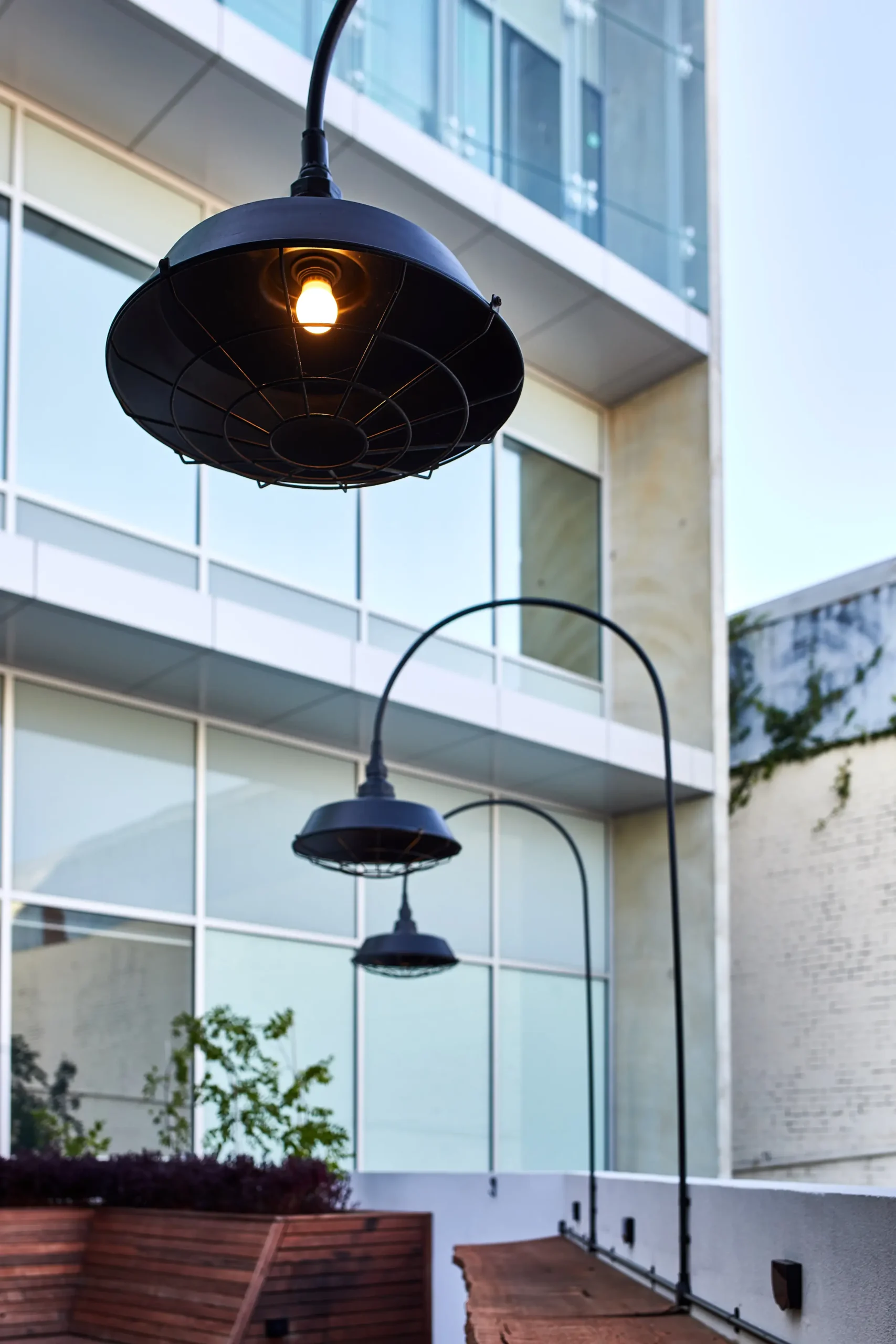
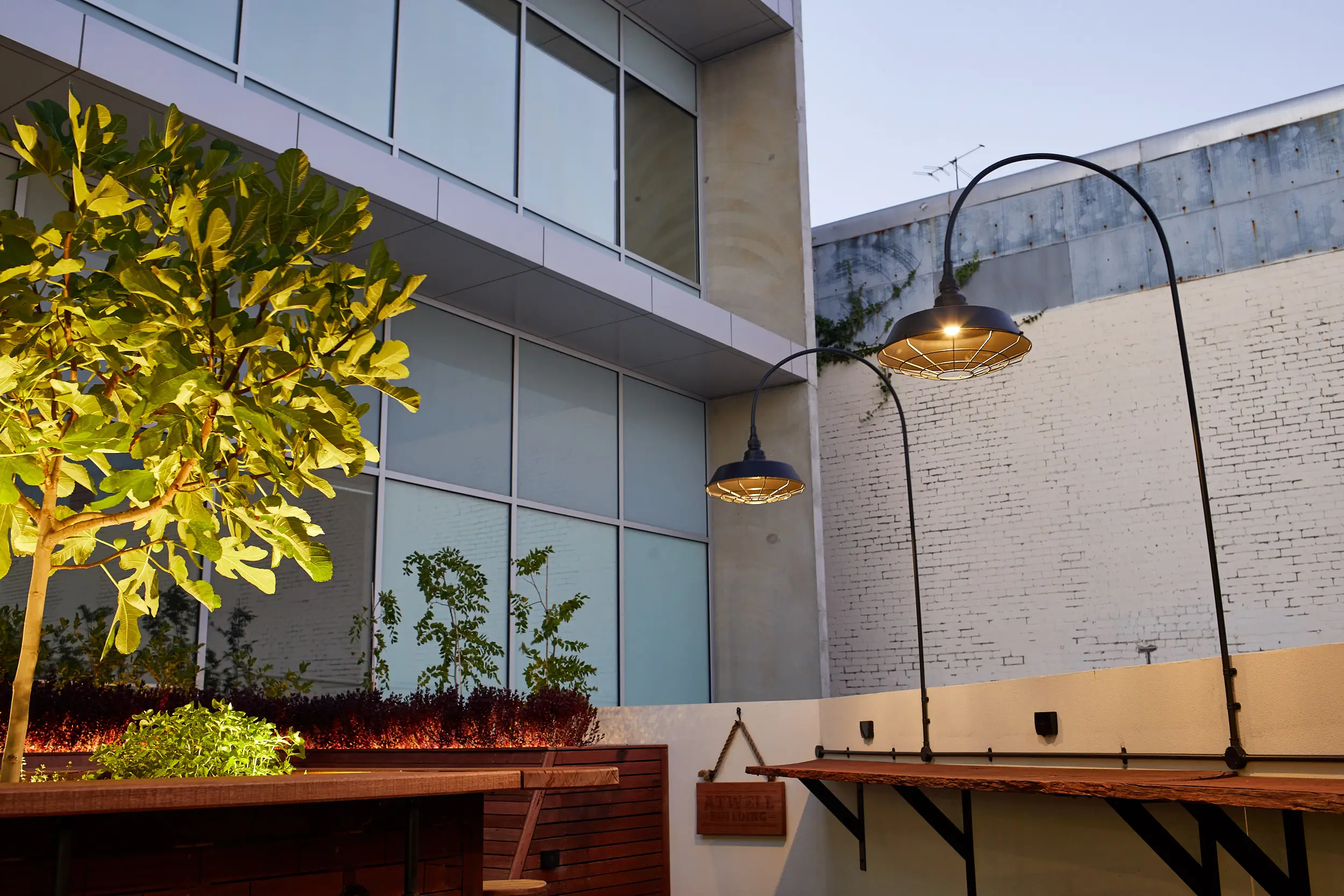
The signature of the job. Each fitting hangs off a long black arm that curves up and out over the counter, so the light source sits above and slightly in front of the person at the bar rather than directly overhead. The shades are shallow dishes, which push the light down onto the timber and keep it out of the eyes of anybody sitting there. Wire cage guards over the lamps do two things. They protect the lamp from a stray elbow, and they break up the light into the soft, patterned glow that gives the whole area the jetty look.
Warm light, deliberately
Colour temperature is the decision most people never get asked about and it is the one that decides how a place feels. Warm light, down at the candlelight and firelight end of the scale, makes a space somewhere you want to sit. Cool white reads as a service station. On a job like this the light itself does more for the atmosphere than the fitting does, and it costs nothing extra to get right at the time.
Fittings that are allowed to move
Hanging fittings outdoors swing. That is the effect we wanted, and it is also a mechanical problem to solve rather than ignore. Anything that moves in the wind for years needs the movement to happen at a point designed to take it, and the cable supported so the flexing never works its way back to a termination. A pendant that looks beautiful on install night and rattles its connections loose over two winters is not a good outcome.
Power and USB at the bar
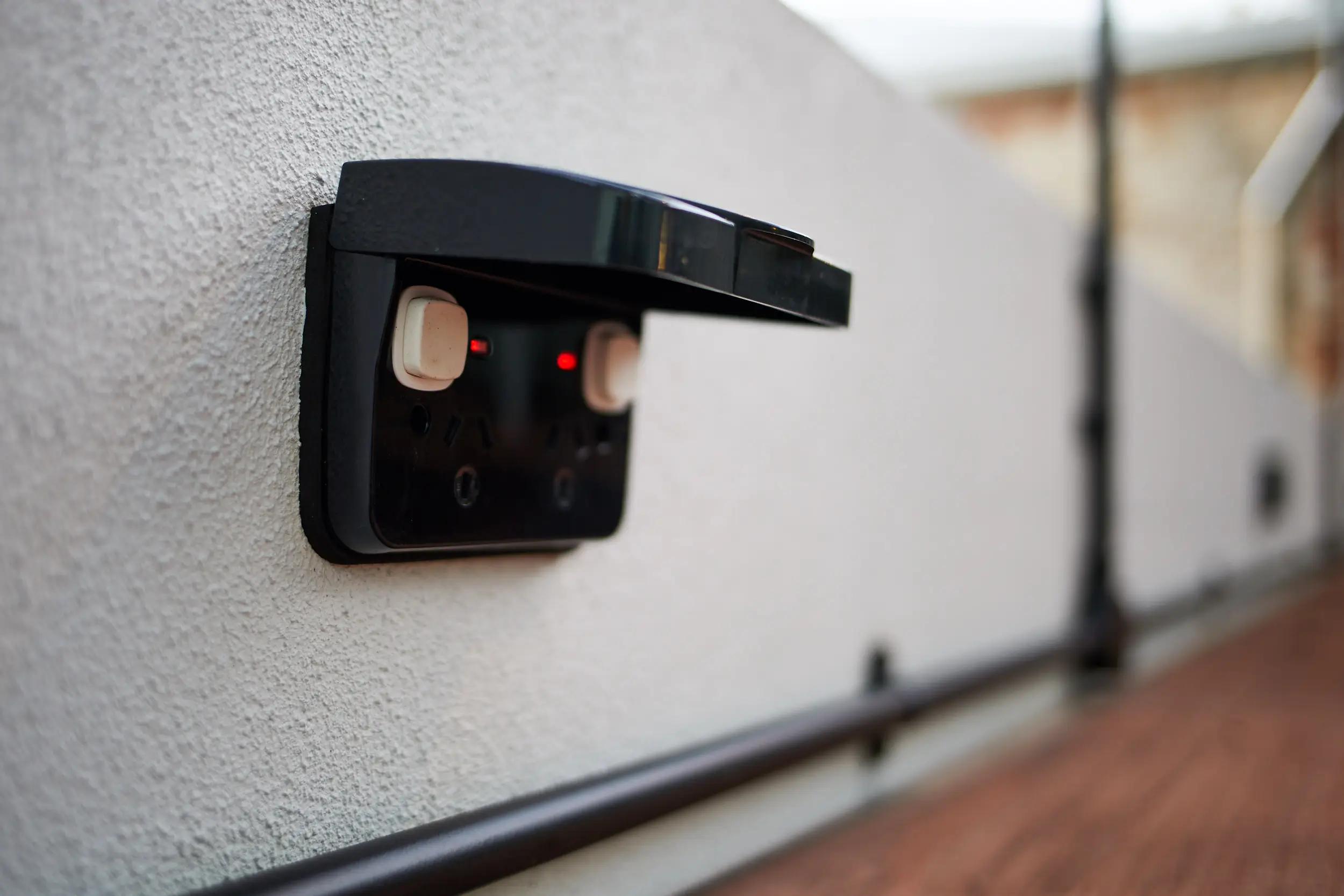
Every alfresco area built now needs charging, and it is far cheaper to put it in during the build than to add it afterwards. We ran weatherproof double outlets along the counter with hinged covers, positioned under the overhang and out of the direct weather, plus USB outlets so people are not hunting for an adaptor. Everything outside is RCD protected.
Feature garden lighting
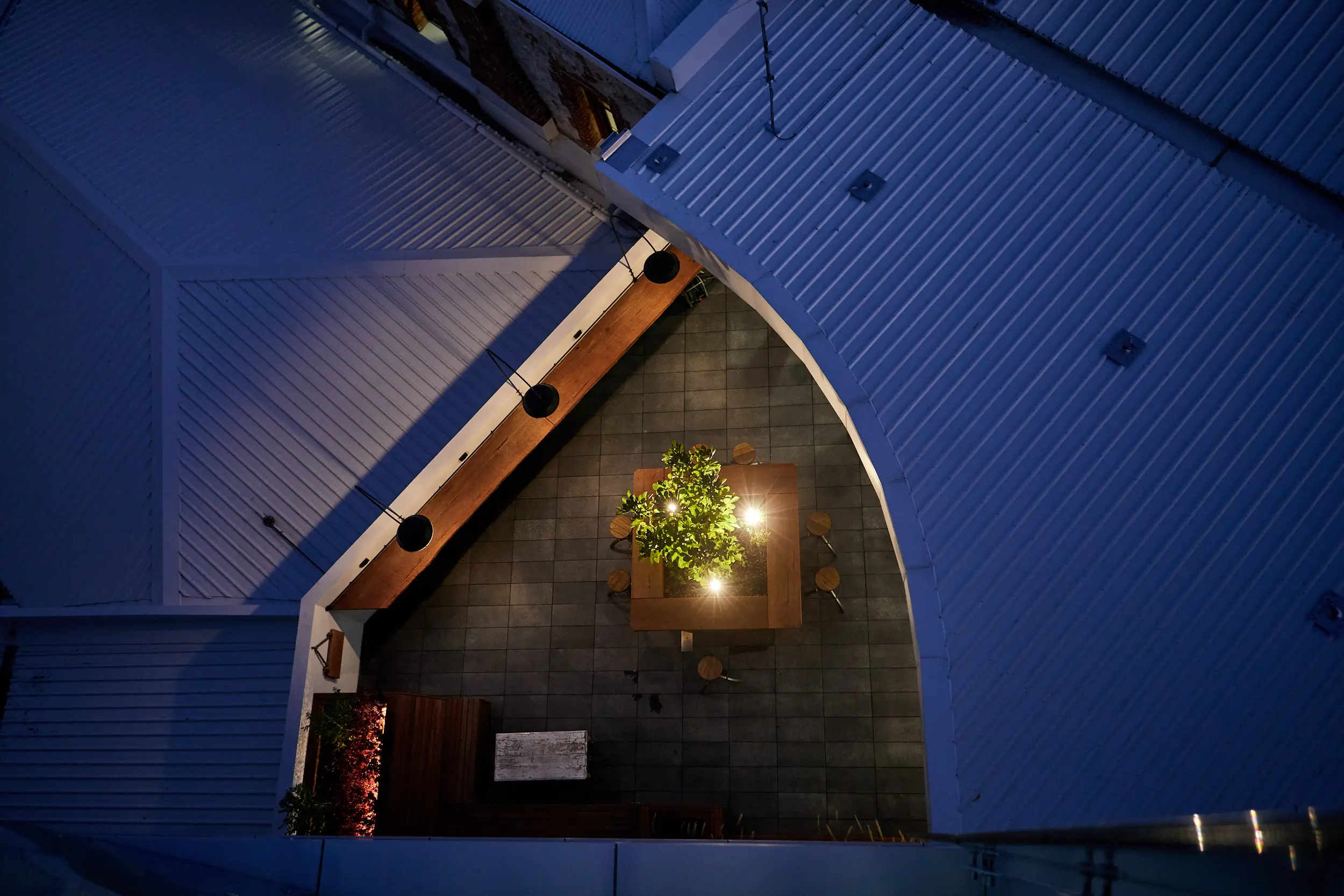
The fig tree in the middle of the courtyard is lit from the base, which lifts the canopy out of the dark and gives the space a ceiling it would not otherwise have. The planter beds along the edges are lit low and warm so the boundary of the area reads without a single fitting being visible. This is the part of an outdoor lighting design people notice without being able to say why.
Surface run conduit, on purpose
The arcade sits in an old building and the courtyard walls are not something you go chasing into. All the wiring is surface run in black conduit, set out square, following the lines of the structure. Done carelessly that is an eyesore. Done deliberately, in a finish that matches the fittings, it reads as part of the design, and it comes back off the wall without leaving a mark, which is what you want in a building like this one.
The result
The courtyard now works as an outdoor bar after dark. The counter is lit where people stand, the communal table has its own pool of light, the fig tree glows from underneath, and the areas in between are left dark on purpose. Nothing glares. Nothing is lit at the level of an inspection lamp. And the fittings move in the wind, which is the detail that makes people ask about it.
Like every job, it came with an Electrical Safety Certificate for the work carried out.
What to take from it if you are building an alfresco area
- Decide the feeling before you choose the fittings. Every good outdoor lighting result starts with a reference, whether that is a jetty, a beer garden or somebody’s back verandah. Pick one. It makes the fifty small decisions afterwards consistent instead of arbitrary.
- Low and warm beats high and bright. Light down onto the surfaces people use, from close range, in a warm colour temperature. One bright fitting in the middle of the ceiling will undo an otherwise good design on its own.
- Ask about colour temperature by name. It is printed on the box, it costs nothing to specify, and it makes more difference to how a space feels than almost anything else. Get it decided before the fittings are ordered, not after they are up.
- Put the power in during the build. Weatherproof outlets and USB points cost very little while the frame is still open and the cable runs are accessible. Retrofitting them into a finished timber bar costs several times as much and never looks as tidy.
- Outdoors is a specification, not a location. Fittings, outlets, enclosures and fixings all need to suit where they are actually going. Near the coast that matters more, not less. Indoor rated gear installed outside looks fine for one summer.
- Get the electrician in while the carpenter is still there. This is the same point we make about kitchens. The mounting positions, the cable routes and the switching are all straightforward while the structure is being built and awkward afterwards. Coordinating it costs nothing and it is the difference between a considered result and a compromise.
Project gallery
Similar projects
Lighting Signage That Has to Work From the Road
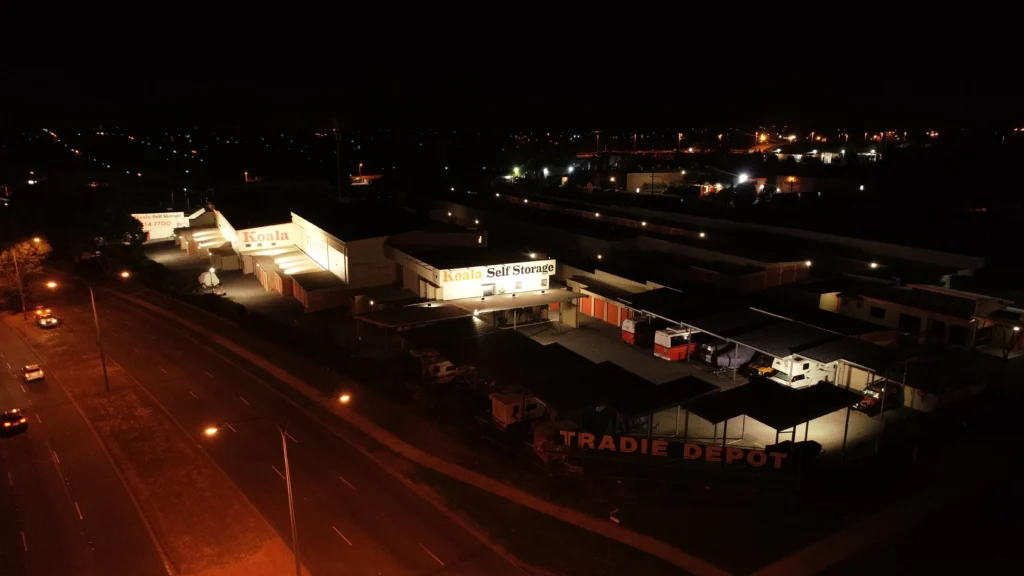
Koala Self Storage had new signage on Leach Highway and lighting that was not showing it off. We redesigned it with asymmetric LED floodlights,…
View project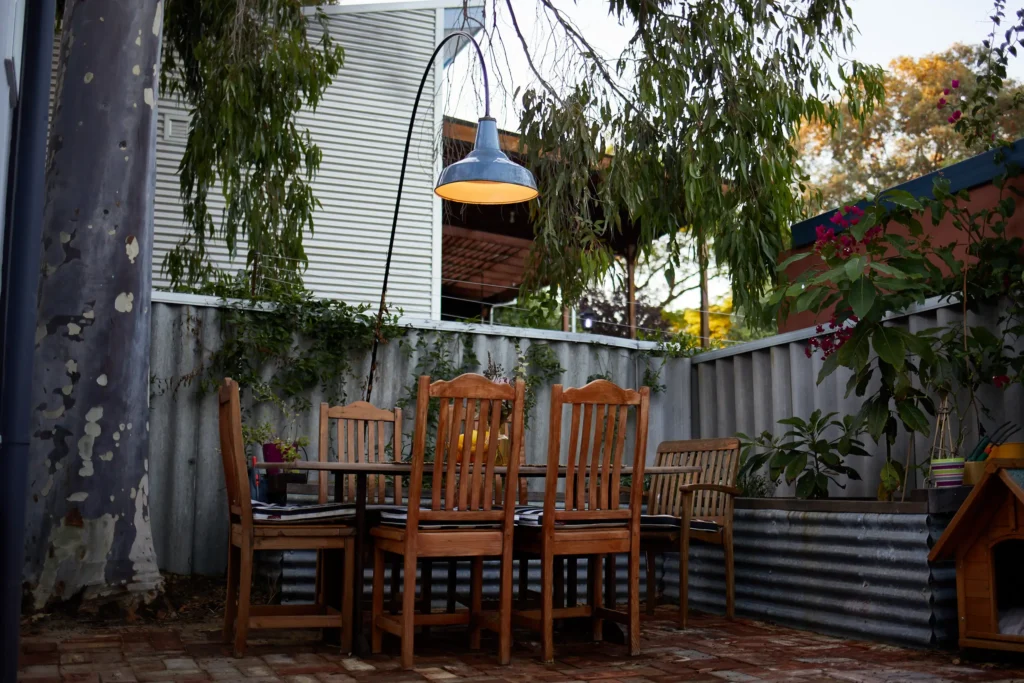
One Old Warehouse Light, and Nothing Across the Sky
A Fremantle client wanted something with more character over his outdoor table, and the sky above his courtyard left clear. We sourced and recycled…
View project
Commercial LED Lighting Upgrade
Osborne ParkReplacing failing fluorescent lighting across an office and warehouse tenancy with LED, staged around trading so the business kept operating.
View projectFrequently Asked Questions.
Can't find the Answer? Reach out to us and we will be happy to answer any of your questions
What sort of lighting works best in an outdoor alfresco area?
Several small pools of warm light at low mounting height, rather than one bright source overhead. Light the surfaces people actually use, the bar top, the table, the steps and the planting, and leave the space between them darker. That contrast is what makes an outdoor area feel like an evening instead of a lit room.
What colour temperature should outdoor bar lighting be?
Can you put power points and USB outlets outside?
Does being near the ocean change what fittings I should use?
When should I get an electrician involved in an outdoor build?
Need a Sparky? Lets Go!
Fill in the form or give us a call on the details below and we will arrange a booking