




One Old Warehouse Light, and Nothing Across the Sky An Outdoor Table Light in Fremantle
A Fremantle client wanted something with more character over his outdoor table, and the sky above his courtyard left clear. We sourced and recycled an old warehouse light to do it.

Most outdoor tables in Perth get lit one of three ways. A floodlight goes up on the wall of the house, which lights the table from the side, in the wrong colour, and puts everybody’s shadow across their own dinner. Or a string of festoon lights gets run from the gutter to the fence, which looks good for a season and puts a set of cables straight across the middle of the sky. Or nothing gets installed at all and the table goes unused after about six in the evening, which is the most common outcome of the three.
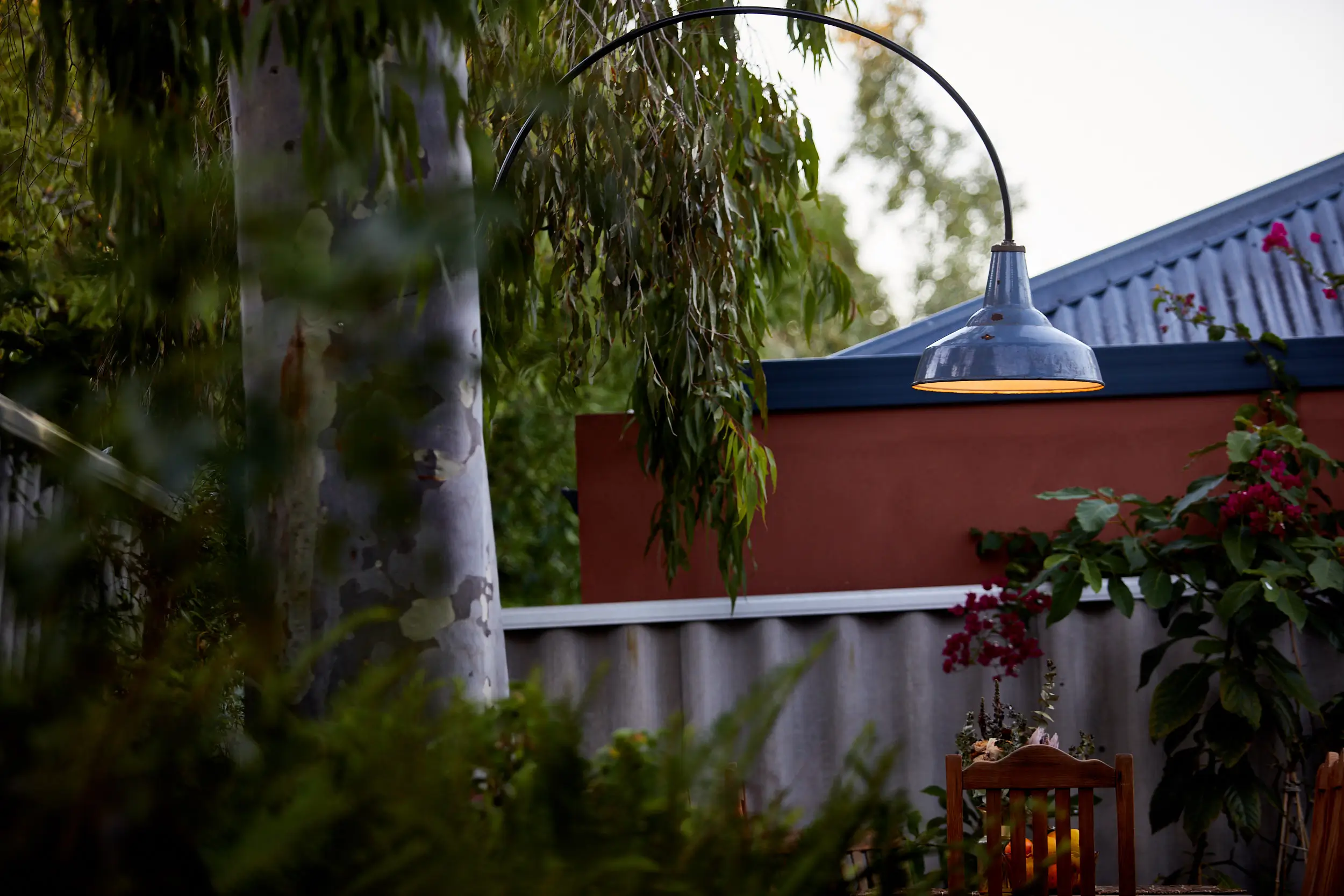
This client in Fremantle did not want any of them. He wanted something with a bit more character over his outdoor table, and he had one firm condition. Nothing was to cross the sky. No festoon strings, no catenary wire, no cable running from the house to the fence. Look up from the table and you should see the gum tree and the sky, and that is all.
That is a good brief. It is also the part of the job that decides everything else.
Why lighting an outdoor table is harder than it looks
Inside a house, a light over a dining table is the easiest job on the board. There is a ceiling. The ceiling has a cavity above it. The cable goes through the cavity and comes out where you want it.
Outdoors there is no ceiling and no cavity. There is nothing above the table at all, which is the entire point of sitting there. So every outdoor pendant becomes the same problem: how do you get a light source to hang above a table in open air, with a cable feeding it, without the way you did it becoming the thing you look at.
The three usual answers each solve it by putting something across the sky. A pergola. A wire. A string of festoons. All perfectly good options, and all of them ruled out here.
Which leaves one answer. Come at it from the side.
The fitting: an old warehouse light, recycled
We sourced a second-hand industrial shade for this job. A proper old warehouse light, a deep spun steel dish of the kind that used to hang in rows over a factory floor, with the finish worn back on the outside and still bright on the inside.
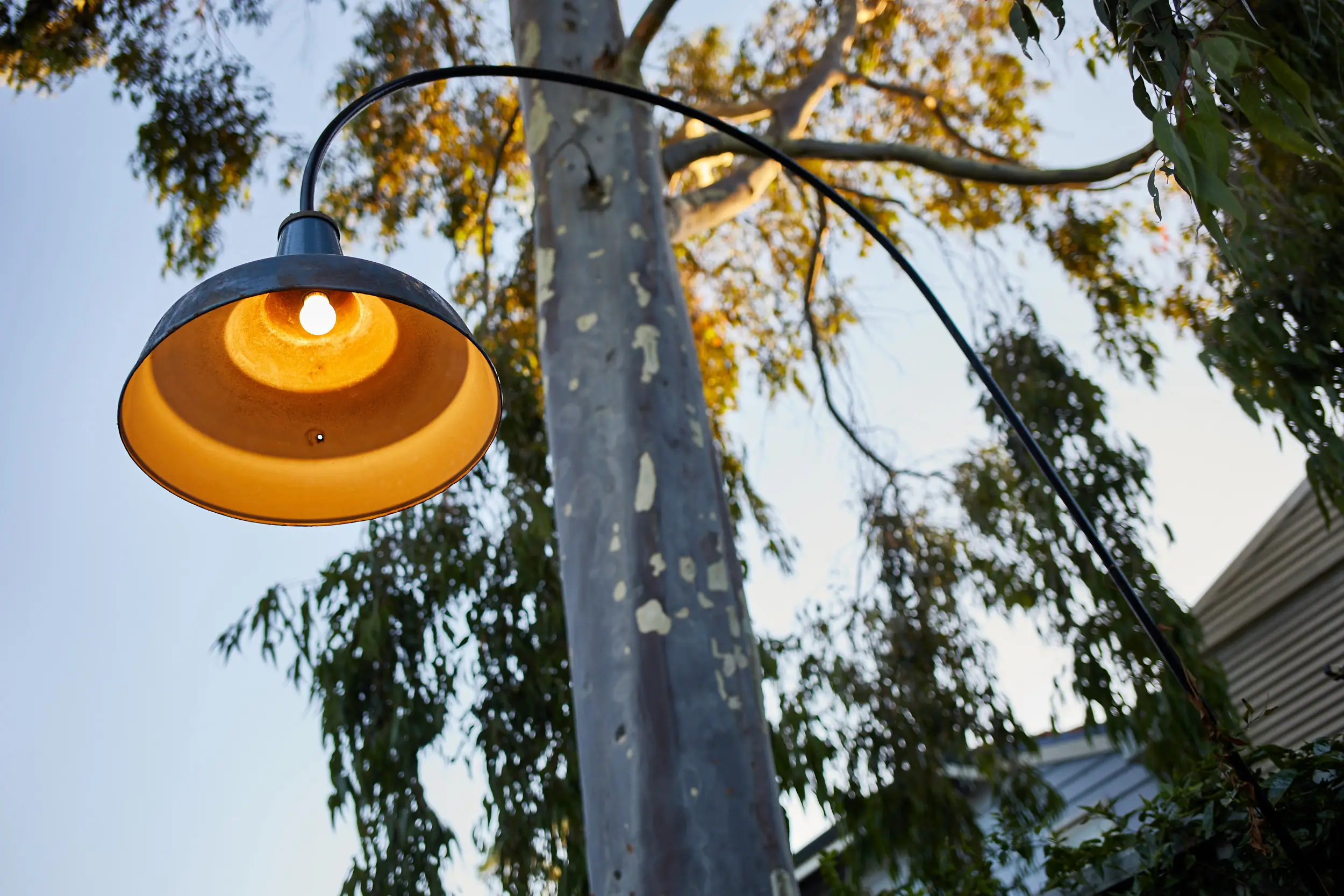
There are reasons those old fittings work so well outdoors, and they are the same reasons they were made that way in the first place.
- The shape does the work. A deep dish with a wide mouth throws light down and holds it in. It is not decorative. It was designed to put light on a workbench and keep it out of the eyes of the person standing at it, which is exactly what you want over a dinner table.
- They were built to be looked at from below. These fittings were made for high ceilings in big rooms, so they are scaled to be seen from a distance and from underneath. Most modern outdoor lights are scaled to be seen from across a small courtyard. Hang a warehouse shade over a table and it reads as an object, not a fixture.
- The steel weathers well. It has already been in service somewhere for decades. The finish is honest, and it is not going to look worse for another Perth summer.
- Nobody else has one. The client wanted eclectic. There is not much that is more eclectic than a fitting with a working life behind it.
Making a salvaged fitting safe, which is the part that matters
This is the section to read if you have a nice old light sitting in the shed.
A second-hand fitting is a completely reasonable thing to install. Reusing one is better than buying new, they are usually built far better than their modern equivalents, and there is nothing about age that makes a fitting unsafe on its own.
What makes it unsafe is the wiring inside it, and that is always original.
Old flex goes brittle. Old rubber insulation cracks and falls off the conductors when you flex it. Old lampholders are often unearthed, or earthed to something that has since corroded. Wiring colours from another era mean nothing today, and a fitting that came out of a UK or a mid-century Australian factory may not have an earth arrangement that translates at all.
So an old fitting does not get hung up and switched on. It gets stripped and rewired. Everything electrical inside it comes out and is replaced: new lampholder, new flex, new terminations, and the metal body of the fitting properly earthed, because a steel shade hanging in the open over a table where people sit is the last thing you want unearthed. Then it gets tested before it goes anywhere near a bracket.
Done that way, a salvaged fitting is as safe as anything in a box at the wholesaler. Skipped, it is a piece of the 1950s hanging over your family. It is not a weekend job, and it is worth knowing that the fitting itself is usually the cheap part of the exercise.
The arm, and where the cable went
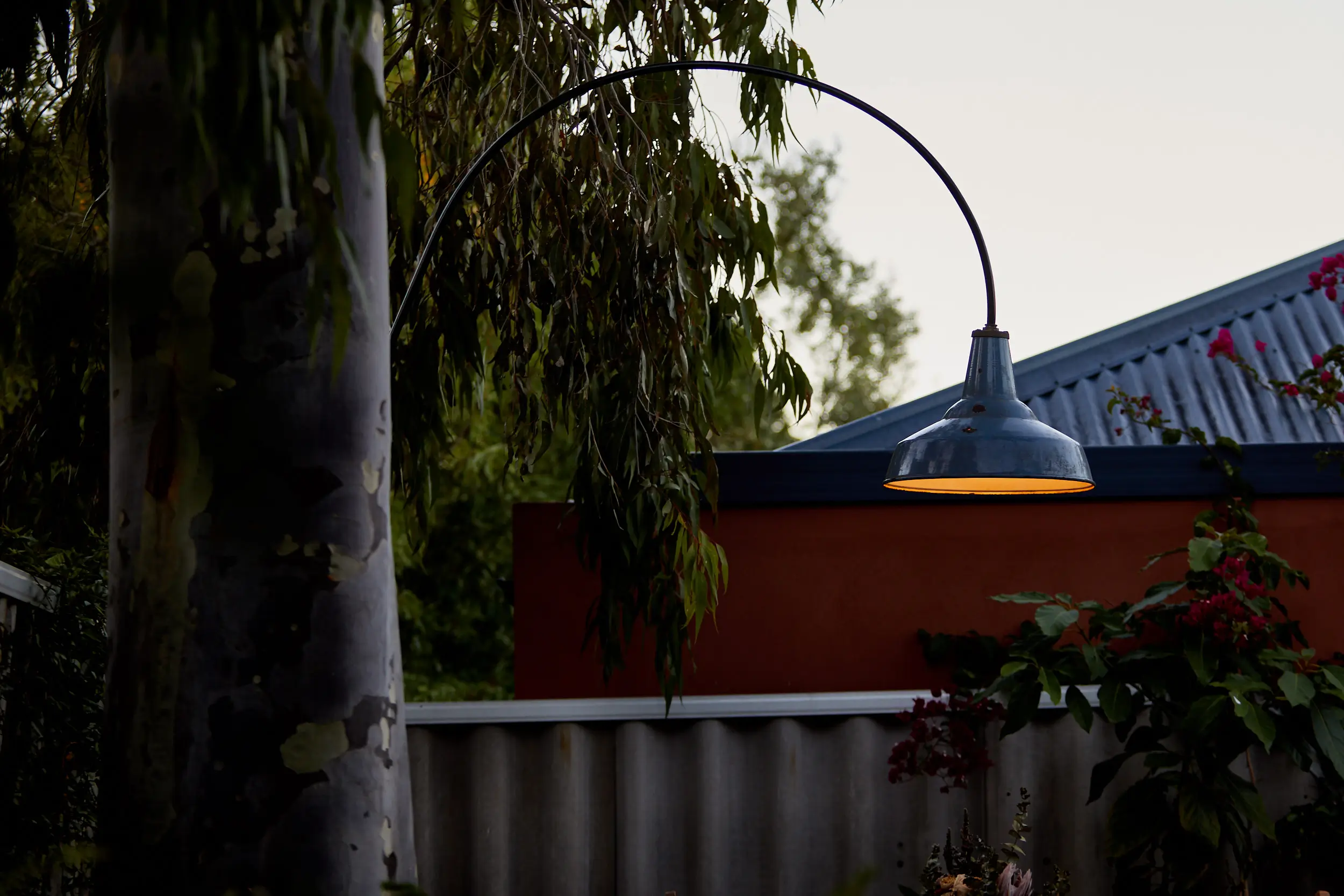
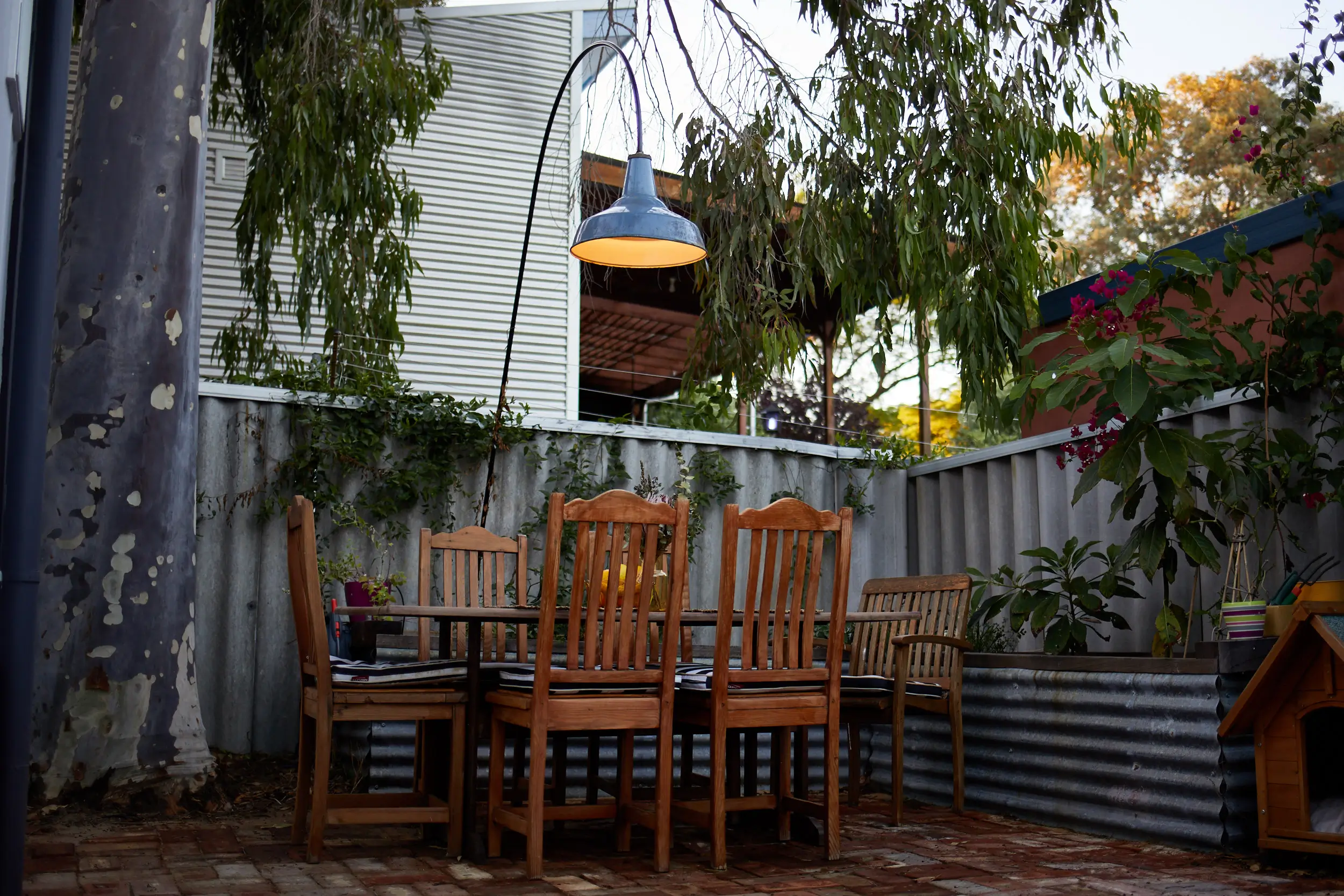
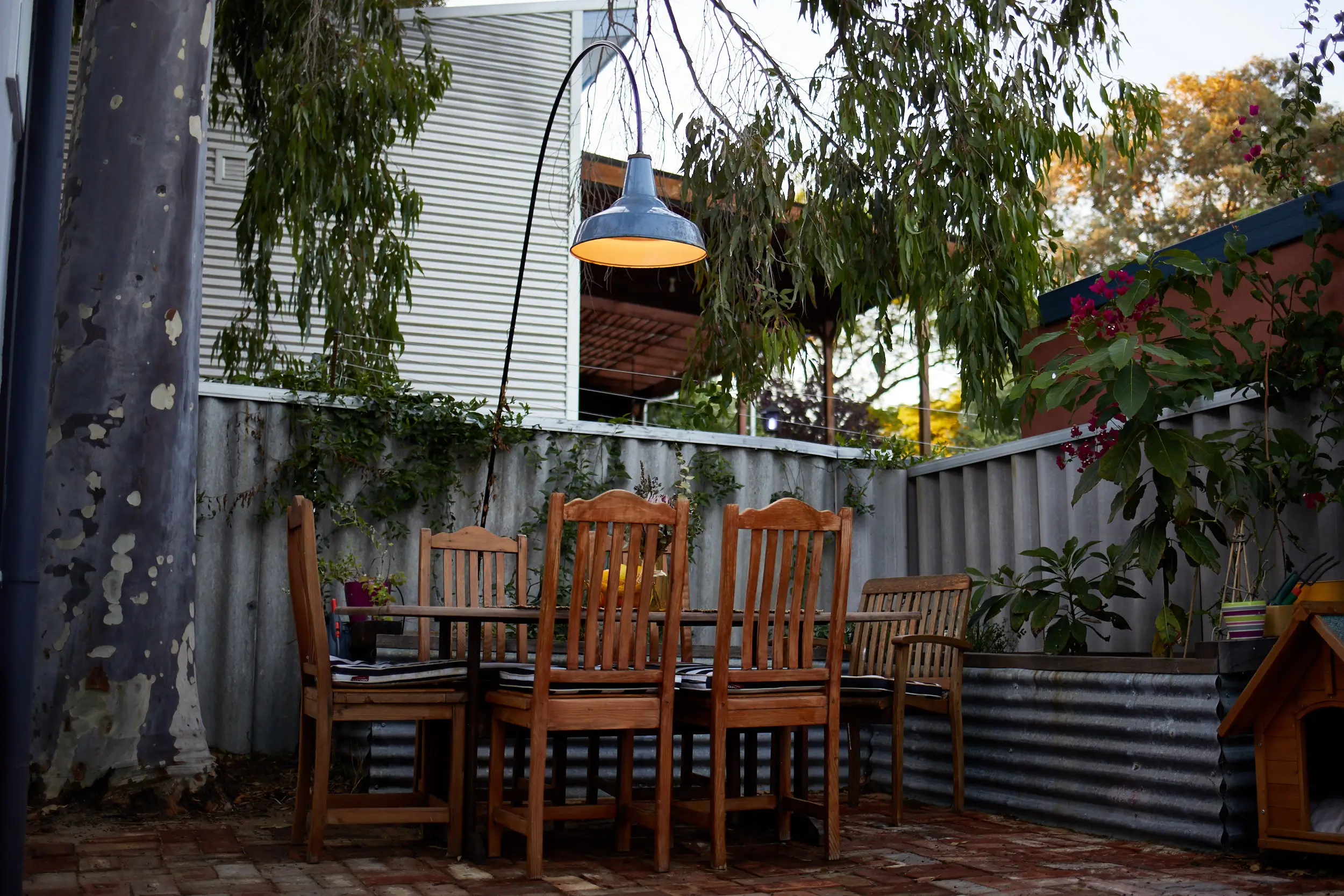
The fitting hangs from a single steel arm, mounted at the edge of the courtyard beside the gum tree, curving up and out over the table.
The whole point of the arm is that it carries the cable inside it. The supply runs up through the steelwork and out to the lampholder, so there is no visible flex, no drop, and nothing spanning the courtyard. From the table you see a black line curving overhead against the sky and a light on the end of it, and that is the entire installation.
Reach matters more than height on a job like this. The arm is long enough to bring the light source out over the middle of the table rather than off to one side, so the pool of light lands where people are actually eating. And because the fitting hangs from a point out in the open rather than off a wall, the light comes from above rather than from the side, which is what stops everybody sitting in their own shadow.
The circuit is RCD protected, and the fitting is switched from the house rather than being something you go outside to turn on.
One other detail worth naming: the arm is fixed to its own mounting, not to the tree. Trees are not mounting points. They move, they grow, and a fixing strapped to a living trunk works loose or bites in over the years. Where a light needs to appear to come from a tree, the right answer is a structure beside it.
The result
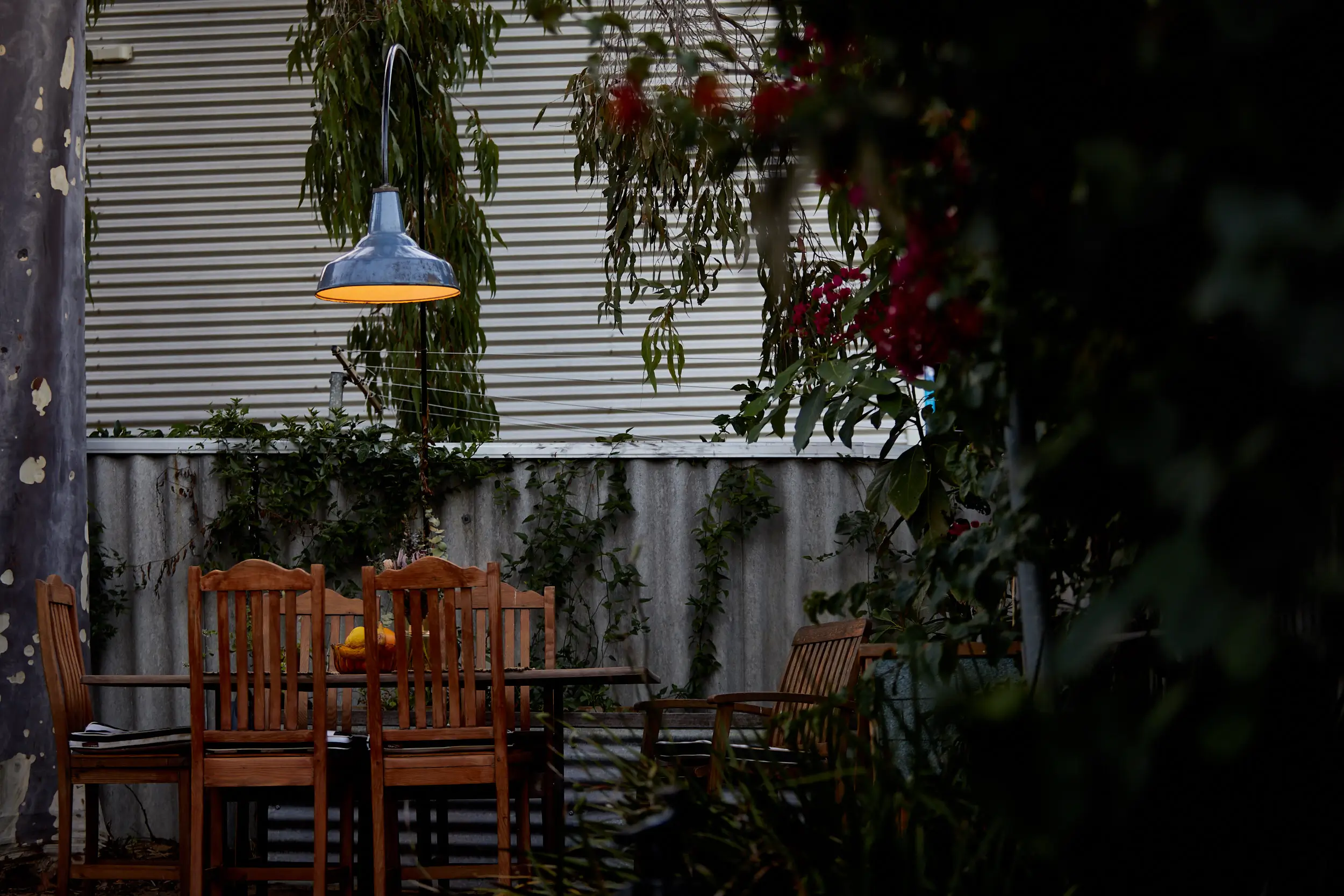
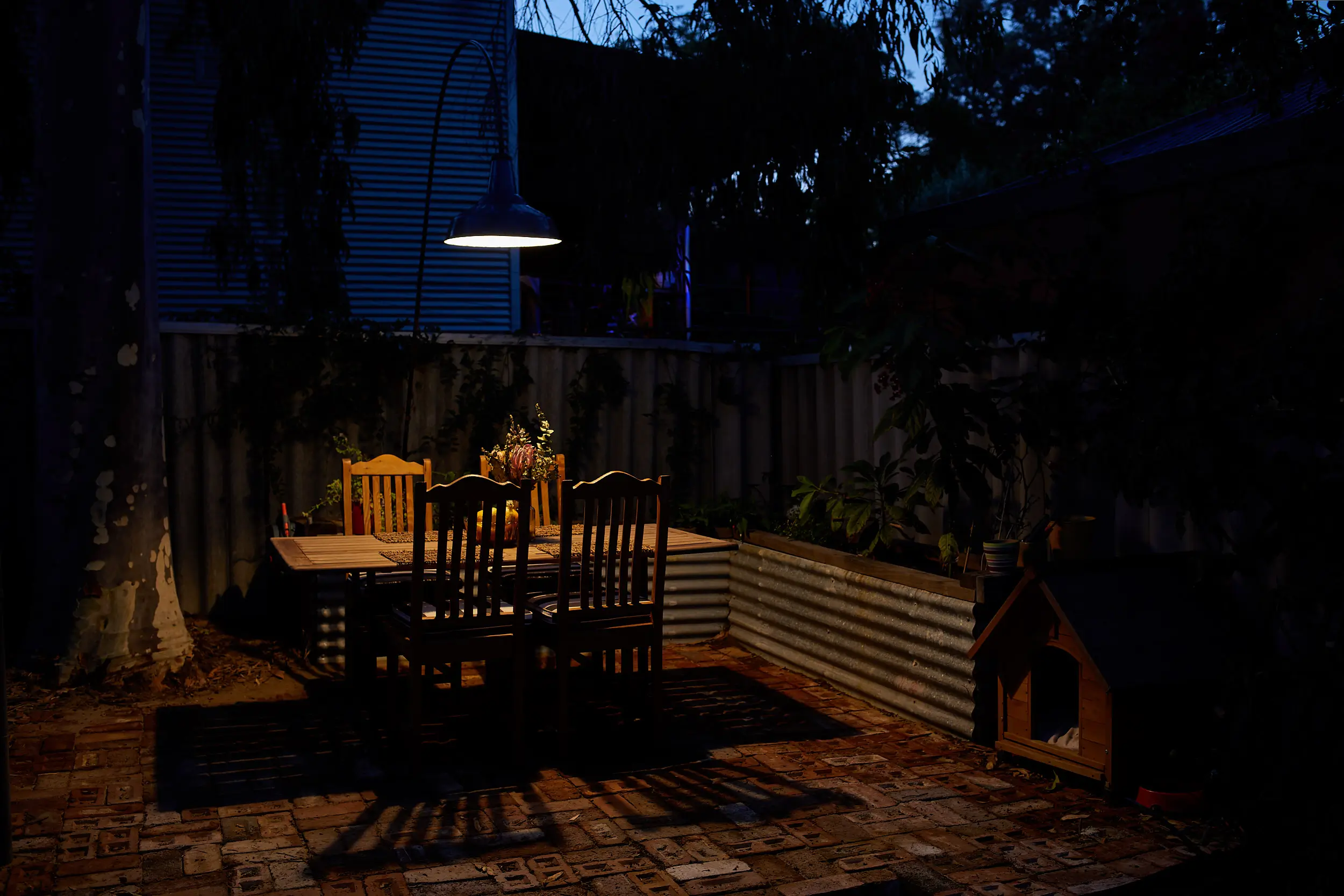
At night the courtyard reads exactly as it should. One warm pool of light sits over the table and the brick paving around it. The garden beds, the fence and the far corners fall away into dark. Nobody is lit from the side, nothing glares, and the light level is a long way below what you would put in a workshop, which is the whole idea.
Look up from the table and there is the gum tree, the shade of an old warehouse light, and clear sky.
The client was still sending us photos of it months afterwards, which is not something that happens on most jobs. We liked it as much as he did.
Like every job, it came with an Electrical Safety Certificate for the work carried out.
What to take from it if you are lighting an outdoor area
- Light the table, not the yard. One warm source, low, directly over the surface people use, will do more than four bright fittings around the perimeter. Flood the whole garden evenly and it stops feeling like an evening.
- Decide where the cable goes before you fall in love with the fitting. This is the decision that shapes an outdoor lighting job. A pendant needs something to hang from and a route for its supply, and working that out first is what separates a considered result from a compromise with a cable stapled to a fence.
- A second-hand fitting is a good idea and a rewire. Bring us the light you found. Budget for it to be stripped and rewired properly, because that is what makes it safe, and it is not optional.
- Ask about colour temperature by name. Warm light makes an outdoor area somewhere you want to sit. Cool white makes it a service station. It costs nothing to specify and it is decided when the lamp is bought, not afterwards.
- Outdoors is a specification, not a location. Fittings, outlets, glands and fixings all need to suit where they are actually going, and near the coast that matters more rather than less. Fremantle certainly counts.
- Do not fix anything to a tree. It grows, it moves, and the fixing loses either way.
Project gallery
Similar projects
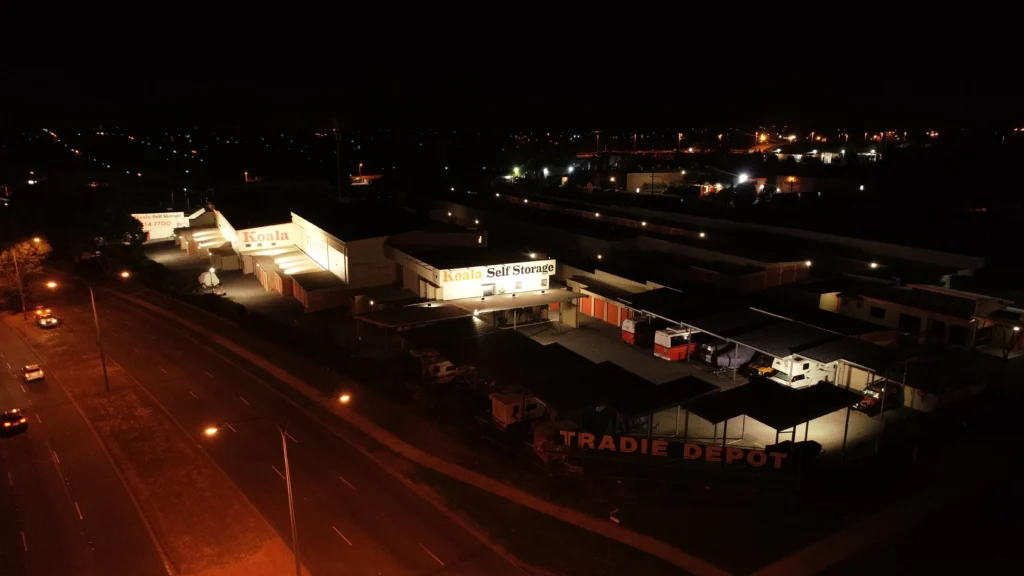
Lighting Signage That Has to Work From the Road
Koala Self Storage had new signage on Leach Highway and lighting that was not showing it off. We redesigned it with asymmetric LED floodlights,…
View project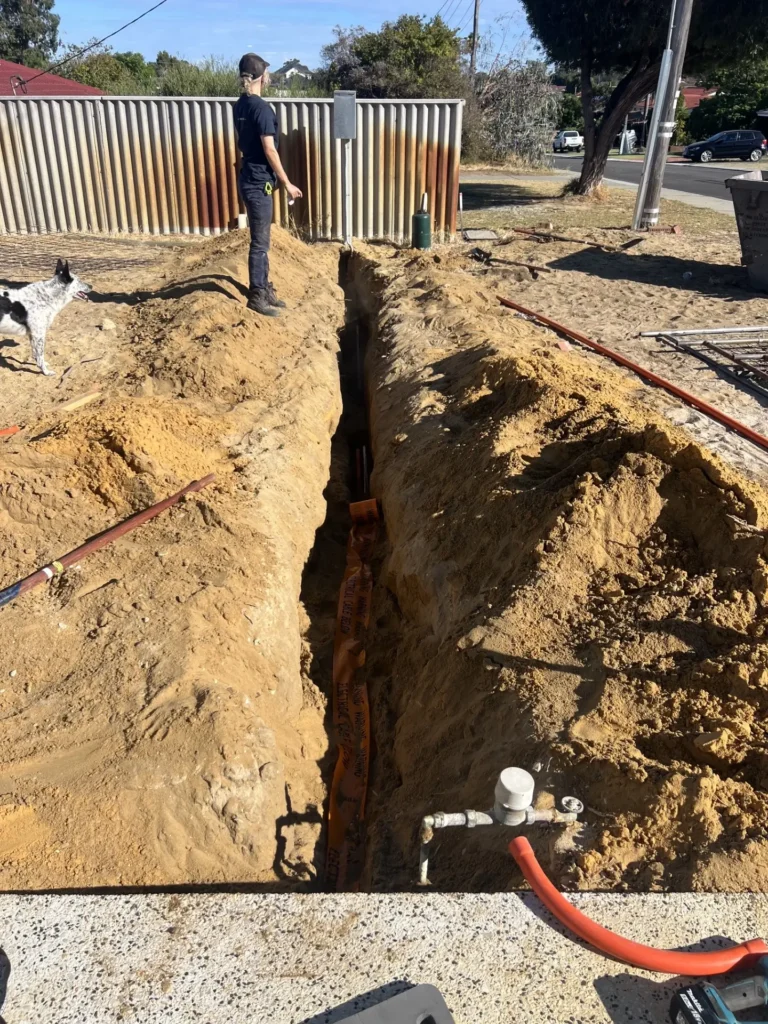
Power to a Third Lot in Warwick
The rear lot of a three lot subdivision in Warwick had no power and no easy route to it. We handled the Western Power…
View project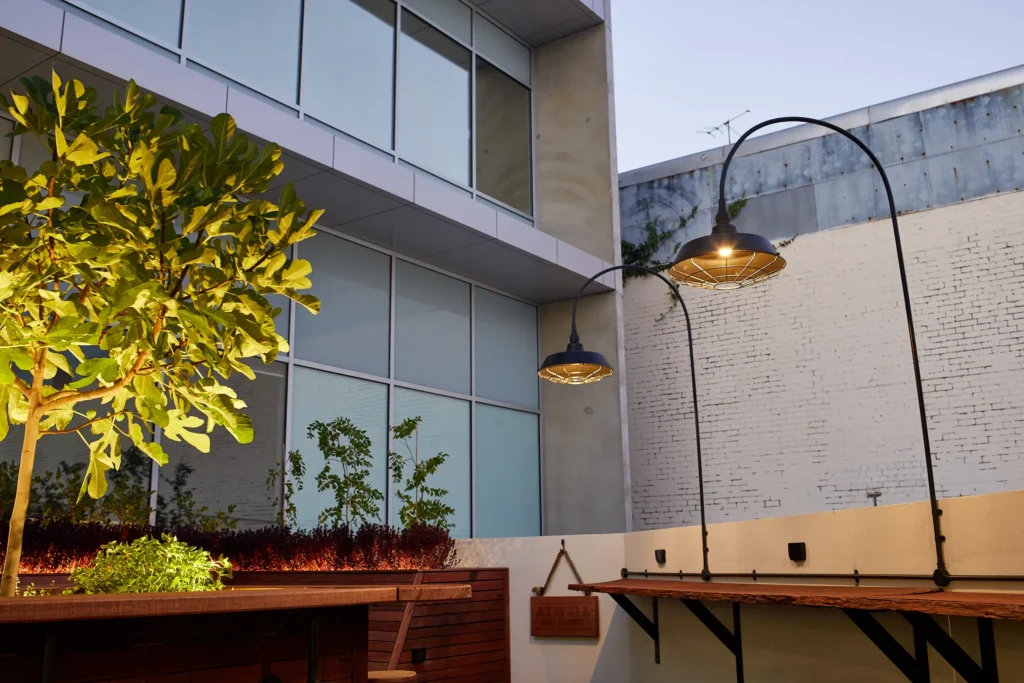
Lighting Designed to Move With the Wind
The businesses of Atwell Arcade in Fremantle were building a timber bar in their shared courtyard. We designed and installed the lighting, taking the…
View projectFrequently Asked Questions.
Can't find the Answer? Reach out to us and we will be happy to answer any of your questions
Can an electrician install a second-hand or vintage light fitting?
Yes, provided it is made electrically sound first. In practice that means stripping out everything electrical inside it and replacing it, so a new lampholder, new flex, new terminations and the metal body properly earthed, then testing it before it is installed. The fitting’s shell, shade and bracket are usually fine and are the reason you wanted it. The wiring inside it never is, because it is as old as the fitting.
How do you light an outdoor table without wires running across the yard?
What sort of light works best over an outdoor dining table?
Can I mount a light on a tree?
Do outdoor lights need a safety switch?
Will an outdoor light fitting survive near the coast?
Need a Sparky? Lets Go!
Fill in the form or give us a call on the details below and we will arrange a booking